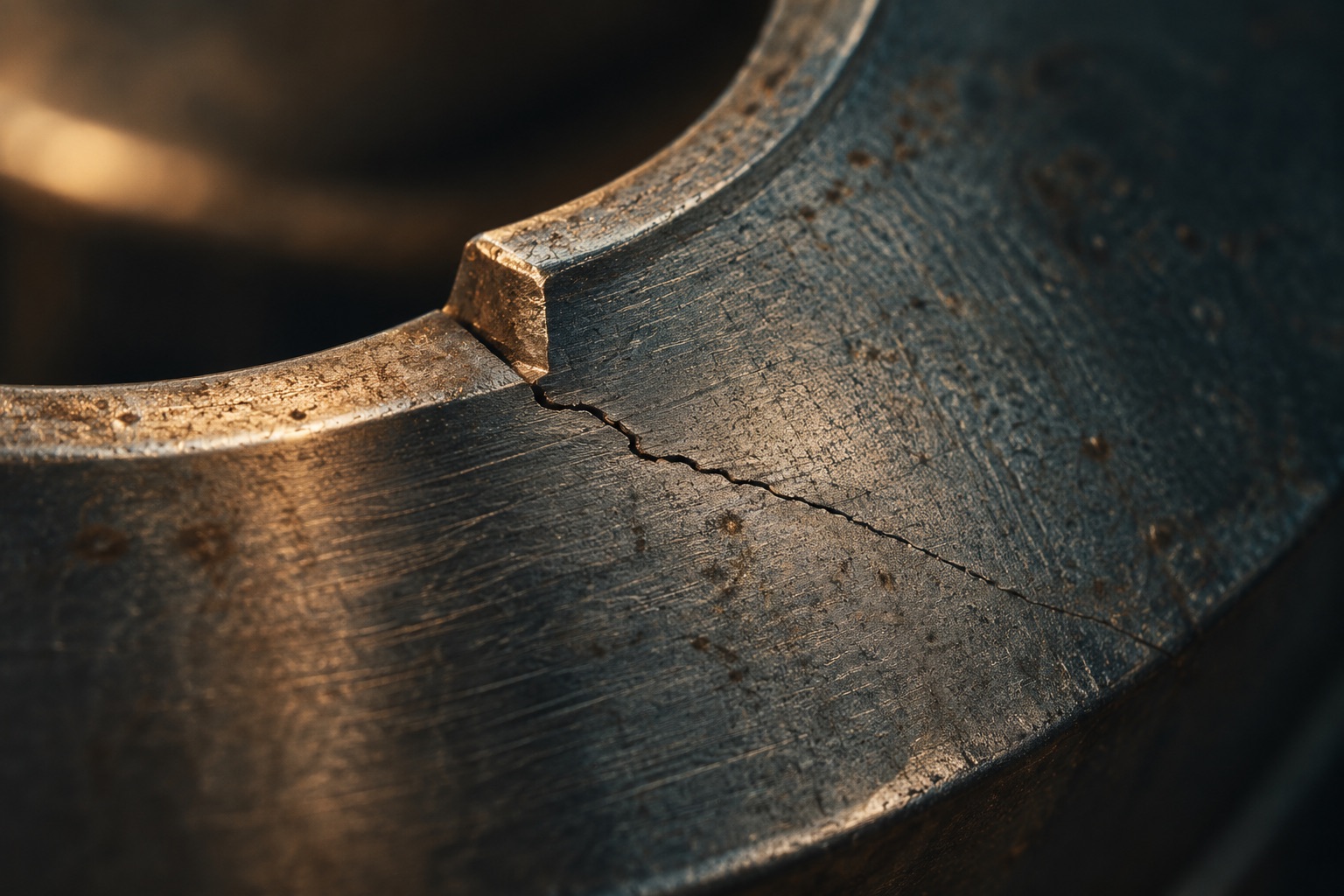
A dark line crosses our artistic metal surface. It looks like the beginning of an event. In a real component, however, it might be the visible trace of a longer history. Understanding that history requires distinguishing loading, local material behaviour and complete fracture.
Fatigue is not metal feeling tired
The word sounds human: something endures for a long time and eventually gets tired. Material fatigue instead concerns a technical history of repeated loading. An old object and a frequently loaded object are therefore not equivalent. A 1985 article by Lankford and Leverant, recorded in NASA’s archive, addresses processes at fatigue crack tips. Its accessible abstract leads directly to a useful question: what actually happens during cyclic loading, and how well do models describe it? [1]
Loading is not distributed equally everywhere
University of Cambridge teaching material explains stress concentration at an idealised flaw. In a simple elastic model, local stress at a sharp crack tip can greatly exceed the nominal stress away from the flaw. The model has limitations and is not a complete calculation for every damaged object. It nevertheless changes our perspective: an apparently evenly loaded metal surface need not have the same internal condition everywhere. The shape and surroundings of a flaw can matter greatly to local material behaviour. [3]
Loading, crack growth, fracture: three questions.
This overview arranges a possible relationship. It is neither an object’s service-life curve nor a sequence of equal time intervals.
- Loading
A history, not an age
Repeated loading matters to fatigue processes. Years alone do not describe that history. [1]
- Crack tip
Local conditions matter
Stress can be elevated at flaws. Experiments investigate material behaviour at a crack tip and test models of it. [1] [3]
- Fracture
Growth differs from complete failure
A crack can initially grow stably under particular conditions. Complete failure is a different question requiring further information. [2]
An editorial explanation. A flaw may already exist, and cracks can have different causes. No loads, permissible crack sizes or remaining cycles are calculated here. [1] [2] [3]
A research article examines the crack tip
Lankford and Leverant describe experimental methods used to test assumptions about fatigue crack tips. These include cyclic loading inside a scanning electron microscope. An assertion that a crack is growing becomes an investigation of material behaviour under defined conditions. The abstract reports how observations helped refine existing models and develop new ones. We read this as historical research published in 1985, not a new investigation conducted in 2026 or a measurement of our illustration. [1]
Distinguish crack growth from final fracture
A crack does not mean that an object completely separates at that precise moment. Cambridge discusses stable crack growth and situations in which resistance to further growth changes. The R-curves explained there belong to fracture mechanics for particular materials. They are not a universal clock for metal fatigue. Our account needs the careful distinction: growth of a flaw, resistance of the material and complete failure are connected, but they are not interchangeable names for one event. [2]
Why we do not invent a failure curve
A curve showing a steadily lengthening crack and a red endpoint would be attractive. Without appropriate data, it would suggest more precision than we possess. An actual history depends on factors including material, geometry, loading history and initial flaws. The sources checked here supply no service-life prediction for an arbitrary everyday object. Our diagram therefore arranges questions rather than numbers. Nor does it show a universal fraction of useful life during which a crack must remain invisible. [1] [2] [3]
The dark line does not reveal its cause
A visible crack can draw attention. Its appearance alone does not demonstrate that repeated loading caused it. Equally, a smooth surface does not establish that an object remains unchanged inside. Accordingly, the illustration is deliberately not labelled a verified fatigue fracture. It provides a visual subject while the sources explain different approaches to investigation. A photograph, a fracture-mechanics model and an experiment at a crack tip each provide different kinds of information about a material’s behaviour.
Observation and assessment perform different tasks
Careful looking may reveal that something has changed. That is a valuable beginning. Whether a loaded component can continue in use requires an appropriate assessment, not our ability to identify a line in a picture. This article therefore explains relationships rather than offering an inspection procedure. It aims to help frame a more precise question: which loading history and which material response would an investigation actually need to establish here? The observation becomes a starting point for an appropriately scaled inquiry.
Change begins before the conspicuous moment
The interesting moment is not only when something breaks. It also lies in processes that were previously localised and difficult to see. This perspective does not make every object automatically suspect; it makes change understandable as a history shaped by conditions. Calendar time, loading history and the visibility of a trace are different scales. Keeping them distinct helps explain why the visible fracture point need not mark the beginning of the entire story.
What does this trace reveal?
Look at the images and choose the statement each can support. The explanation also identifies what needs further observation.
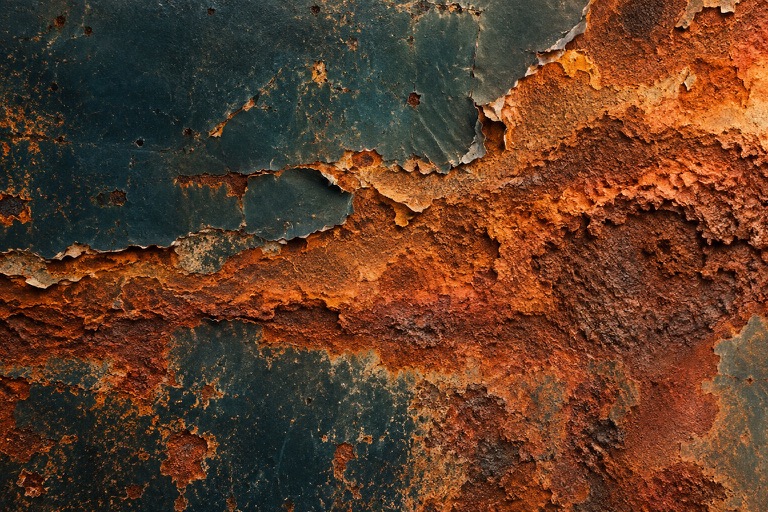
All four images are artistic AI illustrations, not documented material samples. This activity practises asking questions; it does not diagnose damage.
 AI ILLUSTRATION
Rust
Which statement is appropriate?
Read the explanation
Colour alone cannot date an object or measure material loss. Material, change over time and examination would matter.
Read the story and its sources → AI ILLUSTRATION
Patina
What can green alone establish?
Read the explanation
Composition, adhesion and change also matter. Green layers can represent different conditions.
Read the story and its sources →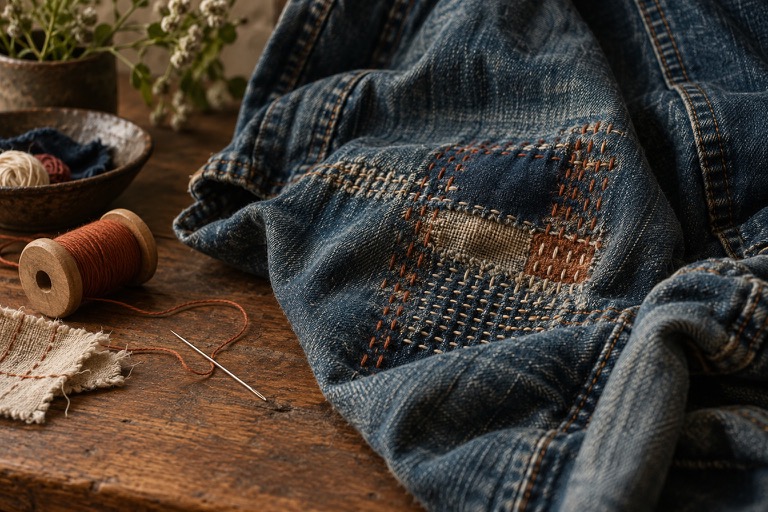 AI ILLUSTRATION
Repair
What does the visible seam tell us?
Read the explanation
Use, material and actual service life remain additional questions. The illustration is not before-and-after evidence.
Read the story and its sources →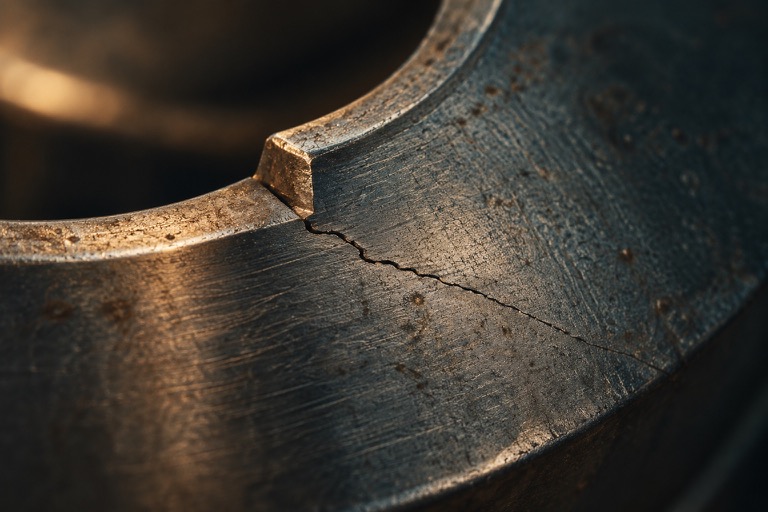 AI ILLUSTRATION
Crack
What does a single crack image fail to establish?
Read the explanation
Repeated loading and examination of the particular object matter for fatigue. Crack shape alone cannot replace them.
Read the story and its sources →Everything runs in your browser. Your inputs are neither stored nor transmitted.
The illustration is neither a micrograph nor a fracture-surface analysis and identifies no fatigue damage. The explanation contains no measurements, component approval or service-life prediction.
Lankford & Leverant (1985) · Experimental characterization of fatigue crack tip processes ↗
NASA archive record of a Journal of Metals article; public abstract read. Describes methods including cyclic loading inside a scanning electron microscope and experimental assessment of models. The record has no downloadable paper; no full text or dataset analysed.
University of Cambridge, DoITPoMS · Sub-critical crack growth and R-curves ↗
Teaching page on stable crack growth, process zones and changing crack resistance in particular materials. R-curves are not general fatigue-life curves. Used for this limited fracture-mechanics distinction.
University of Cambridge, DoITPoMS · Inglis and the crack tip stress idea ↗
Teaching source on stress concentration at an idealised elliptical flaw and limits of that explanation. Used for the principle of local stress elevation, not a calculation for a real component. Same provider as source 2.
Sources checked on 24 October 2026. NASA record examined through its visible abstract without available full text; Cambridge used as teaching material for limited fracture-mechanics questions.