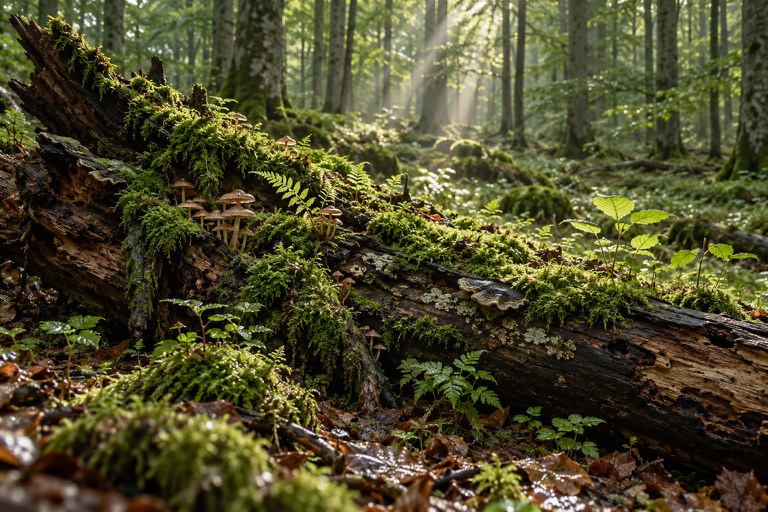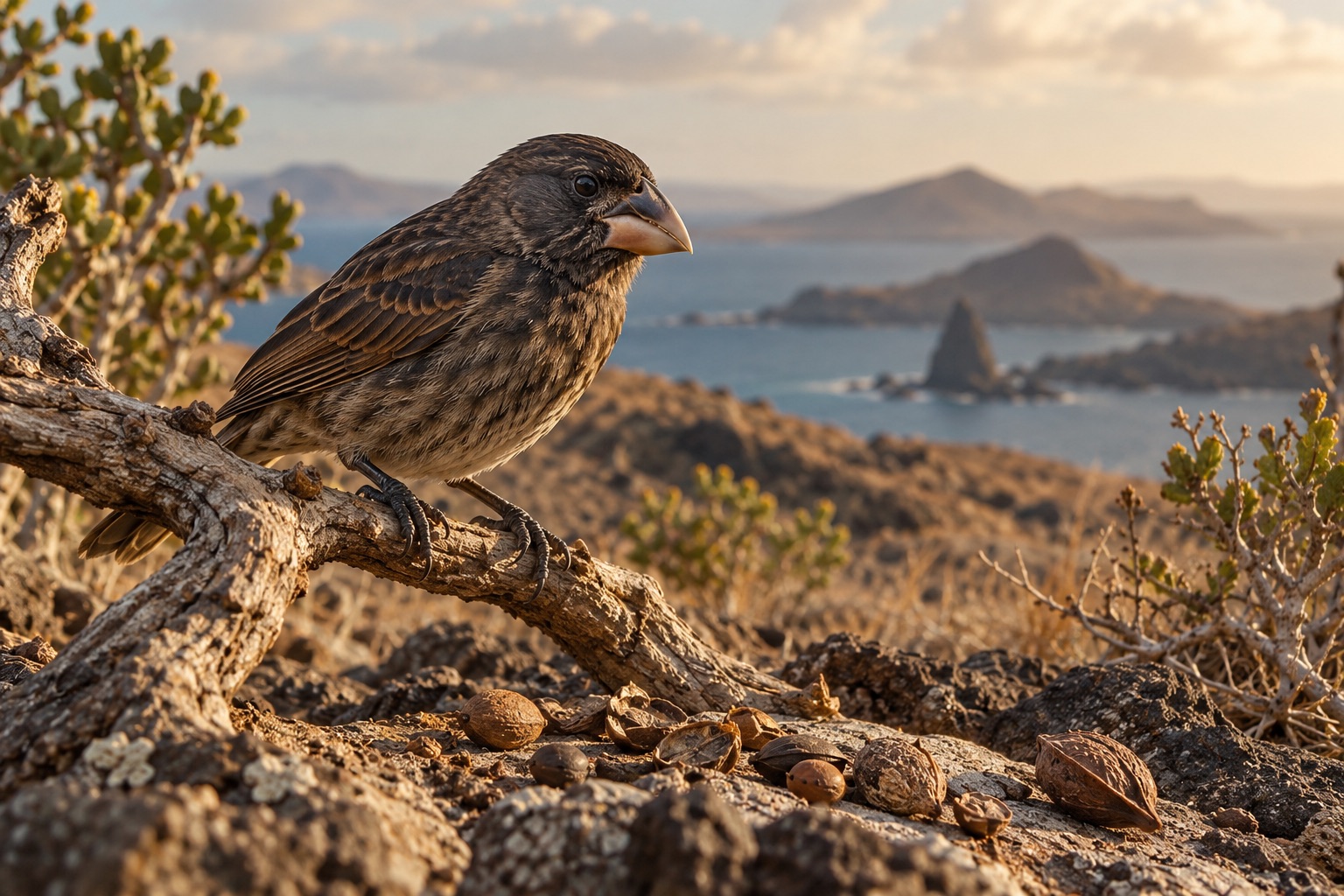
A finch rests on a dry branch. Food is scarce. An appealing story almost writes itself: the bird needs a different beak, so it adapts. But that skips the crucial difference between one body and a population. What actually changes — and how can researchers investigate it?
One word, different processes
In everyday conversation, adapting might mean taking a different route, learning something or getting used to new conditions. A bodily response within one lifetime is another process again: acclimatisation is a form of phenotypic plasticity, the capacity for traits to change in response to environmental conditions. Evolutionary adaptation, by contrast, concerns heritable differences and their success across generations. A body responding to its surroundings is therefore not, by itself, evidence of genetic evolution. The Berkeley explanation makes this distinction clear. [2]
Three things need to come together
Natural selection requires differences. When these are at least partly heritable, and their bearers contribute unequally to the next generation under particular conditions, trait proportions can shift. Survival matters, but it is not the only measure: reproduction matters too. The environment has no plan and assigns no tasks. It changes the conditions under which existing differences have consequences. The diagram below separates steps that work together in nature. [3]
How selection changes proportions.
A deliberately simplified thought experiment with two beak types. Every count is invented for explanation — none comes from the finch study.
Variation
4 smaller · 4 larger beaks
Differences already exist before the conditions change.
Unequal success
3 smaller · 1 larger beak
In this invented example, more smaller-beaked birds survive to reproduce.
Heredity
6 smaller · 2 larger beaks
Heritable differences can shape the next generation. The smaller type is now more common.
The drawn types stand for heritable differences. Real populations have more varied traits and more complex inheritance. Offspring are not copies; the diagram represents neither a particular inheritance pattern nor real survival rates. [3]
A specific place: Daphne Major
One documented case takes us to Daphne Major in the Galápagos Islands. Grant and Grant reported in 2006 on medium ground finches, Geospiza fortis, and competition with large ground finches, Geospiza magnirostris. Their abstract describes beak-size change after the two species had severely depleted the food supply. The study connects long-term observation, natural selection and the high heritability of beak size. This concerns particular populations under particular conditions. It is not a general rule that smaller beaks are superior. [4]
What the genetic study adds
Published in 2016, the study by Lamichhaney and colleagues investigated the genetic basis of this documented competition-and-drought event. The researchers identified a genomic region containing HMGA2 whose variants were associated with different beak sizes. During the drought event studied, genotypes associated with larger beaks were strongly disadvantaged in medium ground finches. This connects genetic differences with observed selection. It does not establish that one gene determines every aspect of beak shape, or that the drought generated a needed variant on demand. [1]
What does not happen to one bird
The finding does not describe an adult finch turning a larger beak into a smaller one when food becomes scarce. It describes differences between birds and unequal success among their bearers. A selective change in population composition can become visible within a generation; heredity links it to subsequent generations. Saying that the population changes is therefore more informative than imagining that each individual has to remodel itself to fit. Our diagram illustrates that principle with invented counts, not measurements from Daphne Major. [1] [3]
An advantage has conditions
Whether a trait is advantageous depends on factors including food and competition. If that context changes, its advantage can change too. Natural selection is therefore not a ladder towards ever better animals. It describes differential reproductive success in a particular environment. Evolution also involves other mechanisms, including mutation, gene flow and genetic drift. Not every change in a trait is an adaptation produced by selection. A closer look therefore starts by asking which process was observed, rather than applying one explanation to every change. [3]
How far the evidence reaches
We read the two original studies here through their publicly accessible abstracts. We explain findings reported there without analysing the complete datasets ourselves. This article supplies no new frequency curve, reconstruction of every survival rate or genetic diagnosis of the illustrated bird. Teaching resources explain the concepts; the research abstracts document the particular case. Those roles complement each other, but should remain distinguishable.
A better question for the next finch
The next time you encounter a claim about adaptation, pause for a moment. Is an individual responding within its lifetime? Or are heritable traits and their frequencies changing within a population? Which environmental conditions and timescale are being considered? Our finch remains on its branch. The story we tell about it becomes more precise: change requires no decision by the bird. It requires an explanation at the right scale.
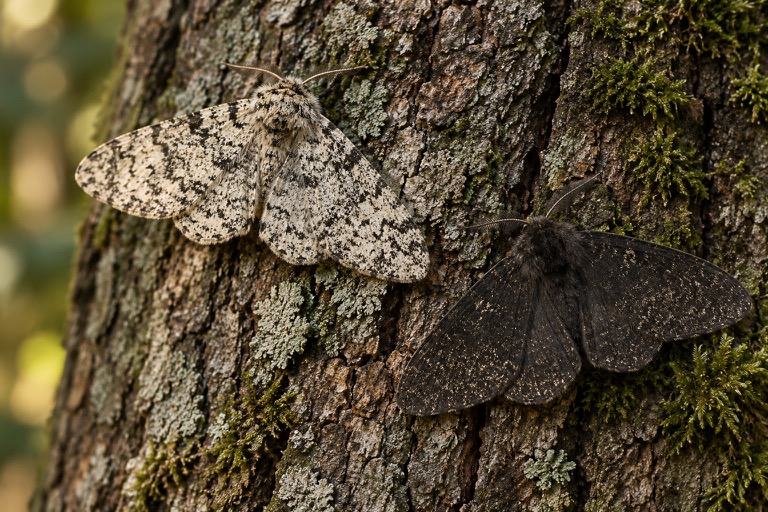
Camouflage under pressure
Find the twelve moths in the field. Then change the background: what is easier to spot now? No time limit or grading.
The search field is created locally.
From visibility to selection
The search game is not a study of birds. The following calculation is independent of your clicks: two inherited colour variants reproduce equally well but differ in survival probability. Well camouflaged: 80%. More conspicuous: initially 40%. Equal initial shares; no mutation, migration or random fluctuations. These numbers are chosen learning assumptions.
Generation 0 · Light 50% · Dark 50%
Calculation and history
New share = previous share × survival probability ÷ sum of both weighted shares. Equal reproduction then replenishes the imagined population. This is a two-type model, not a complete genetic model of peppered moths. Slider changes apply from the next step; changing the background resets the model.
| Generation | Light (%) | Dark (%) | Conspicuous: survival (%) |
|---|
Compare with the story: Adaptation is not a decision. →
Everything runs in your browser. Your inputs are neither stored nor transmitted.
Another view of change.
Watch free on ARTE. The films complement this story; they do not replace the specialist sources discussed above.
Insects — masters of adaptation
Flight, camouflage and living together offer further perspectives on insect diversity.
While watching, consider: Which examples concern inherited traits, and which concern learning or an individual animal’s behaviour?
Listed by ARTE as available until .
Watch on ARTE (German) ↗Animal (R)evolution — our Earth
Animals respond to changing habitats in different ways. An opportunity to distinguish behaviour, physiological responses and evolution.
While watching, consider: Which observations support the explanation, and over what period were they made?
Listed by ARTE as available until .
Watch on ARTE (German) ↗Listing pages checked on 25 October 2026. Regional restrictions and changes may apply. Links lead to the German version; ARTE may offer other audio or subtitle options. No video player is loaded here.
The finch illustration is artistic. It shows no identified study animal, particular genetic variant or reconstruction of the drought. The diagram is our own deliberately simplified thought experiment with invented counts.
Original Science study checked here through its public PubMed abstract. Connects a genomic region containing HMGA2 with beak size and selection in medium ground finches during a drought. The full text and raw data were not analysed separately; no measurement series is reconstructed from the abstract.
UC Berkeley Understanding Evolution · The mysteries of Tibet ↗
University explanation distinguishing acclimatisation as phenotypic plasticity from heritable evolutionary adaptation. Used here for that conceptual distinction.
UC Berkeley Understanding Evolution · Natural Selection ↗
Teaching resource reviewed and updated June 2020: variation, differential reproduction and heredity. Basis for our original diagram; its bird counts are invented examples, not data from this source. Same provider as source 2.
Grant & Grant (2006) · Evolution of character displacement in Darwin’s finches ↗
Original Science study checked through its PubMed abstract. Describes beak-size change in Geospiza fortis in the context of food competition with G. magnirostris, long-term observation and high heritability of beak size. Part of the research context of the later genetic study, not an independent replication.
Sources checked on 24 October 2026. The two research studies were examined through their accessible abstracts; teaching resources and original findings are explained separately.