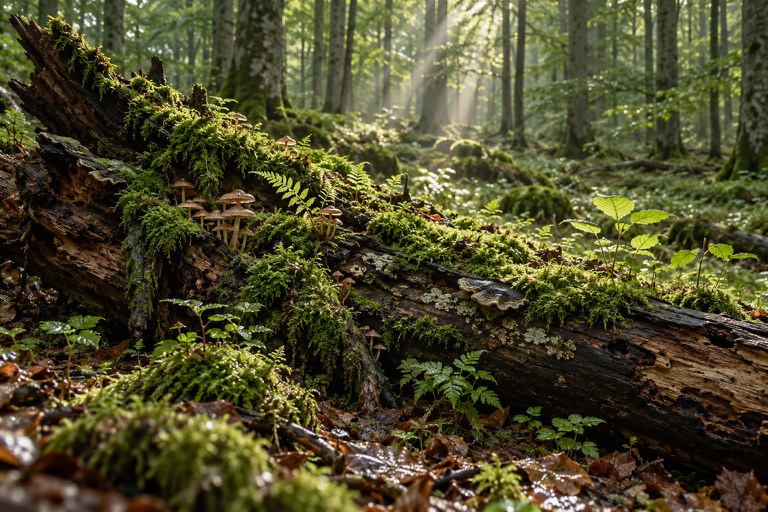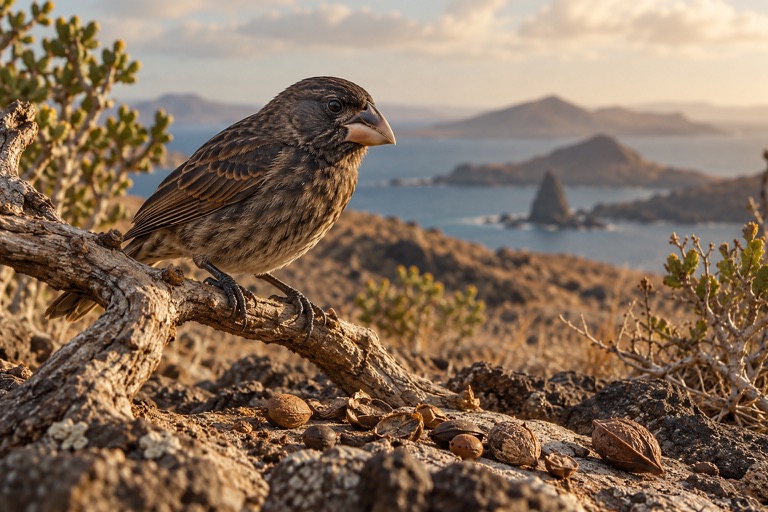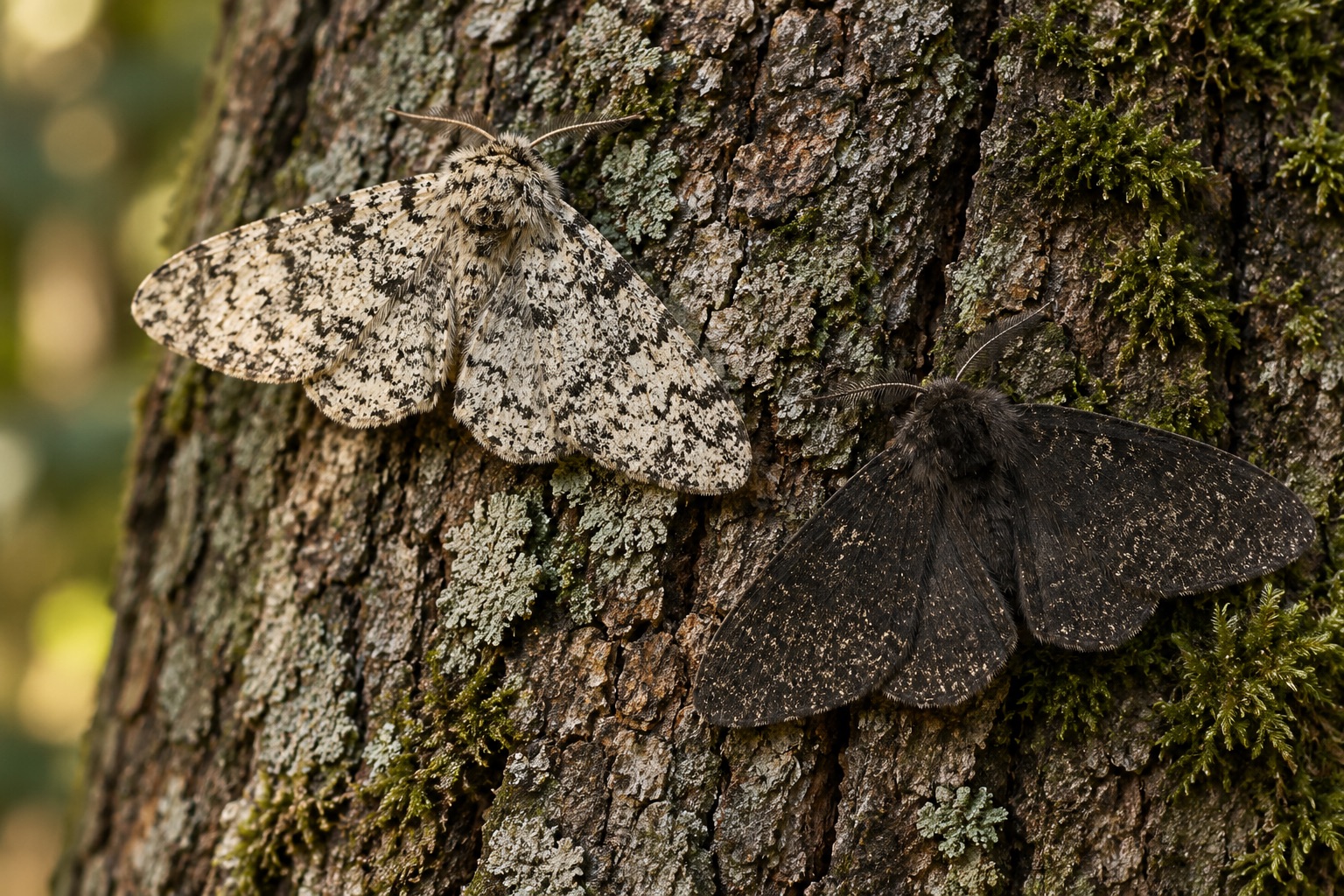
A pale and a dark moth rest on imagined bark. Depending on where we look, one seems to stand out more clearly. The image illustrates a question: can camouflage help determine which animals survive? The answer lies beyond the image, in an investigable relationship between the environment, birds and inherited differences.
A familiar example remains a research question
Colour differences in the British peppered moth, Biston betularia, are inherited. The dark carbonaria form became common in connection with industrialisation; its frequency later declined. The 2012 study by Cook and colleagues examined bird predation as a specific explanation. It also considered weaknesses in earlier experimental arrangements. This matters because a familiar textbook account becomes stronger when its assumptions are investigated again, rather than when its best-known picture is simply repeated. [1]
The experiment considers resting places
Michael Majerus carried out his experiment in a rural garden near Cambridge. Between 2002 and 2007, a total of 4,864 moths were released. They could initially settle on branches; the work used resting sites appropriate to the species and low densities. This addressed concerns including unnatural placement and excessive numbers of moths. Rather than arranging two colours on an attractive patch of bark, the experiment sought to capture encounters between prey and predators more realistically. [1]
Three kinds of evidence, three questions.
An attractive moth image cannot answer every question. This overview distinguishes what each approach observes or investigates.
- Field experiment
Which moths disappear more often?
Pale and dark moths are compared under naturalistic conditions. Some bird attacks are observed directly. [1]
- Genetics
What is associated with colour?
Research on the British dark form identifies a particular DNA insertion in cortex. [2]
- Evolution
What changes?
Inherited variants can differ in success. Frequencies change within a population; individual moths do not deliberately recolour themselves. [3]
An editorial comparison of levels of investigation. The overview contains no invented experimental counts or before-and-after measurements. [1] [2] [3]
Disappearing is not identical to being eaten
The researchers recorded which moths were absent from their resting places after a defined observation period. Because resting peppered moths do not normally fly away during daylight without disturbance, absence was treated as evidence of predation. Some attacks were directly observed through binoculars. The methods distinguish those observations from the inference made for the remaining missing moths. That distinction does not undermine the result. It shows how observations become an analysis that others can examine and question. [1]
The result belongs to a context
The published analysis found stronger selection against the dark form at the relatively unpolluted study site. Together with observed attacks, this supported an important role for visual camouflage. We do not transfer the measured strength of that effect to arbitrary forests or to conditions in 2026. Resting places, surroundings and predators are part of the finding. “Dark is worse” would therefore be as imprecise as “Dark is better”. The interesting question is why a heritable variant suffers greater predation under particular conditions. [1]
Another level of investigation: DNA
The genetic study published by van’t Hof and colleagues in 2016 added another layer. Its accessible abstract describes an insertion of a transposable DNA element in cortex underlying the British dark form. This identifies a genetic difference behind the visible trait; it does not observe a bird attack. Field experiments and genetics therefore perform different roles. Together they connect an inherited variant with the question of the environmental conditions under which its bearers differ in survival. We did not reanalyse the access-restricted full text. [2]
A population changes its composition
An individual moth need not deliberately adjust its wings to match a tree. When inherited differences are associated with unequal success, their proportions can shift across generations. The Berkeley teaching resource explains variation, heredity and differential reproduction. The peppered-moth case thus illustrates change within a species. It does not, by itself, demonstrate the formation of a new species. The visual simplicity of pale and dark should not tempt us to reduce every evolutionary history to precisely two possibilities. [3]
What our illustration cannot reveal
The pictured moths are artistic. Their placement establishes neither a natural resting position nor a scene from the experiment. Their contrast cannot supply a percentage of animals eaten. Our overview therefore separates field observation, genetic findings and explanation at population level. Looking only at the picture offers an invitation to ask questions. Reading the sources makes it possible to examine which investigation actually supports each claim. The two activities can complement one another without being mistaken for the same evidence.
A closer look begins with the method
The next apparently obvious nature image invites a useful question: what exactly was observed, and what is being inferred? A moth may be conspicuous to us without our fully reproducing a bird’s perception. A camouflage story is therefore made convincing by an appropriate comparison rather than the strongest colour effect. Change occurs in the composition of a population — and in our improved understanding of how evidence for that change is established.
Camouflage under pressure
Find the twelve moths in the field. Then change the background: what is easier to spot now? No time limit or grading.
The search field is created locally.
From visibility to selection
The search game is not a study of birds. The following calculation is independent of your clicks: two inherited colour variants reproduce equally well but differ in survival probability. Well camouflaged: 80%. More conspicuous: initially 40%. Equal initial shares; no mutation, migration or random fluctuations. These numbers are chosen learning assumptions.
Generation 0 · Light 50% · Dark 50%
Calculation and history
New share = previous share × survival probability ÷ sum of both weighted shares. Equal reproduction then replenishes the imagined population. This is a two-type model, not a complete genetic model of peppered moths. Slider changes apply from the next step; changing the background resets the model.
| Generation | Light (%) | Dark (%) | Conspicuous: survival (%) |
|---|
Compare with the story: Adaptation is not a decision. →
Everything runs in your browser. Your inputs are neither stored nor transmitted.
Another view of change.
Watch free on ARTE. The films complement this story; they do not replace the specialist sources discussed above.
Insects — masters of adaptation
Flight, camouflage and living together offer further perspectives on insect diversity.
While watching, consider: Which examples concern inherited traits, and which concern learning or an individual animal’s behaviour?
Listed by ARTE as available until .
Watch on ARTE (German) ↗Listing pages checked on 25 October 2026. Regional restrictions and changes may apply. Links lead to the German version; ARTE may offer other audio or subtitle options. No video player is loaded here.
An artistic moth scene, not a photograph from the field experiment, evidence of natural resting positions or a predation measurement. The overview separates levels of investigation.
Public original full text read, including methods and results. Field experiment near Cambridge in 2002–2007 with 4,864 released moths, published in 2012. Directly observed predation is distinguished from inferred explanations for disappearance. Site-specific experiment, not a universal effect size.
Original abstract read; full text requires access. Identifies an insertion of a transposable element in cortex for the British carbonaria form. No independent genomic analysis or universal explanation of every dark moth form.
UC Berkeley Understanding Evolution · Natural Selection ↗
University teaching source reviewed June 2020. Explains variation, heredity and differential reproduction; conceptual support for the historical case, not another peppered-moth study.
Sources checked on 24 October 2026. Cook et al. read as accessible full text; van’t Hof et al. through the original abstract. No independent reanalysis of research data.