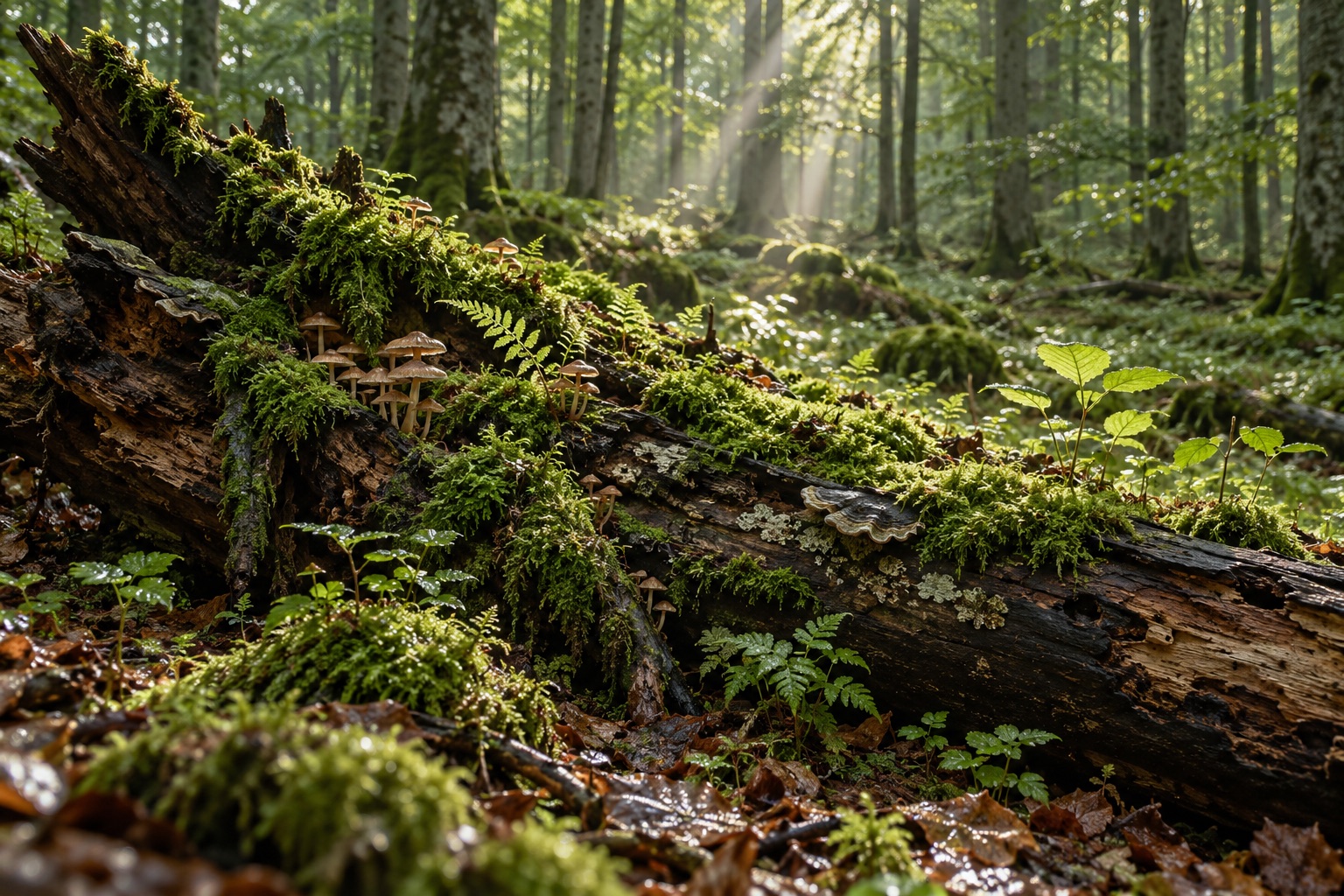
A fallen trunk lies beside the path. It was there yesterday and will still be there tomorrow. Between those glances, little seems to happen. But dead initially describes the tree as an organism. It does not mean that its materials, inhabitants and relationships have stopped changing.
The tree ends, its relationships do not
At Empire Bluff Trail in Sleeping Bear Dunes National Lakeshore, the National Park Service draws attention to rotting logs. Stop five describes organisms using wood and young plants finding moisture, shelter and nutrients within it. The location makes a general idea tangible: the end of a tree and the end of its ecological effects are different events. A fallen trunk can remain involved in the life of a forest long after the tree itself has died. [1]
Decomposition involves activity
Wood does not become soil simply because years pass. Organisms contribute to its breakdown. The NPS explanation names bacteria, insects and fungi, linking decomposition with the release of nutrients previously held in the wood. A visible organism should not be credited with the entire process. A fungal fruiting body indicates a presence, but does not reveal every organism involved or each contribution. What appears to be one quiet surface contains a network of different activities. [1]
One trunk, several processes.
These three perspectives can overlap in time. They are not a fixed sequence with a stopwatch for every forest.
- Material
Wood is broken down
Organisms change the wood itself. Climate and decomposers influence how quickly this happens. [1] [3]
- Habitat
A different place emerges
A decaying trunk offers moisture, shelter and sometimes germination sites. It is more than disappearing material. [1] [2]
- Cycling
Materials move onward
Decomposition makes nutrients available again. Part of the story extends beyond the visible shape of the log. [1]
An editorial explanation based on NPS site descriptions and the research abstract, not measurements of the illustrated trunk. [1] [2] [3]
Why a seedling grows on a log
In Olympic National Park, the NPS describes a particularly striking relationship. Where ground vegetation is dense, many young trees germinate on fallen, decaying trunks. Their roots later reach the ground. As the supporting wood disappears, a row of trees with distinctive root forms can remain. These nurse logs are more than an appealing metaphor: the site description explains a spatial relationship between old wood and new growth. It does not promise that every log produces another tree. [2]
The speed depends on conditions
A 2021 study by Seibold and colleagues shows how much decomposition can vary. Its public abstract describes a field experiment across 55 forest sites on six continents. Temperature, precipitation and the contribution of insects interacted, with different effects across climatic regions. We do not extract a deadline for our pictured log from those findings. The important result is dependence on context: a universal timetable saying that wood disappears after a fixed number of years would conceal those differences. [3]
Habitat and carbon are different questions
A log can provide habitat while its materials are also being transformed. The international study explicitly examines the importance of deadwood decomposition in the carbon cycle. The NPS pages focus instead on observable habitats and germination sites. These questions complement one another, but are not interchangeable. A growing seedling does not calculate a carbon balance. A global estimate of decomposition does not reveal which organisms inhabit one piece of wood. Scale helps determine which claim a source can support. [1] [2] [3]
A forest scene is not a study plot
Our image is artistic. It identifies neither Empire Bluff Trail nor a particular log in Olympic National Park. We also read the study through its abstract rather than independently reanalysing its raw data. Accordingly, we provide no apparently precise curve beneath the picture. A documented photographic sequence of one log could reveal changes in its shape. Identifying the species involved or the chemical processes taking place would require other observations and investigations.
Look carefully without breaking it open
A recognisable location viewed from the path can be enough for a closer look. How does the bark sit? Is a fruiting body visible? Does a seedling stand on the wood or in the ground behind it? Recording a date and a similar viewpoint makes comparisons more useful. Even then, a newly noticed fungus has not necessarily newly appeared: it may previously have been overlooked. The wood need not be pulled apart. Observation should preserve the relationship that makes it interesting.
A beginning does not compensate for everything
The story of new life in dead wood is inviting. It does not make the loss of an old tree insignificant, or establish the condition of an entire forest. The more precise change is our subject: a living tree becomes a different component of a living system. Passing a fallen trunk, we can therefore recognise an ending alongside several continuing stories. Slow change is no less real because it lasts longer than our walk.
Another view of change.
Watch free on ARTE. The films complement this story; they do not replace the specialist sources discussed above.
In the kingdom of fungi
Explore the often hidden role of fungi and the question of how dead material creates new opportunities for life.
While watching, consider: Where does the film show decomposition, and where a relationship between living partners?
Listed by ARTE as available until .
Watch on ARTE (German) ↗Listing pages checked on 25 October 2026. Regional restrictions and changes may apply. Links lead to the German version; ARTE may offer other audio or subtitle options. No video player is loaded here.
An artistic forest scene, not a documented study plot, species inventory or time series. The explanation arranges processes, not a fixed chronological succession.
National Park Service · Empire Bluff Trail, stop 5 ↗
Site interpretation at Sleeping Bear Dunes National Lakeshore, page updated 25 September 2025. Describes decomposition, nutrient release and nurse logs; not a measured time series of one trunk.
National Park Service · Olympic: Temperate Rain Forests ↗
Updated 11 April 2025. Describes seedlings on decaying trunks and later rows of rooted trees in temperate rain forest. Site conditions are not generalised to every forest; same provider as source 1.
Seibold et al. (2021) · The contribution of insects to global forest deadwood decomposition ↗
Original abstract inspected: field experiment across 55 forest sites on six continents, examining climate and insect contributions to decomposition. Full text requires access. No raw-data analysis or transfer of a global rate to the illustrated log.
Sources checked on 24 October 2026: two NPS site descriptions and one accessible research abstract. No independent data analysis.