A pale patch on a stone may initially look like a single being. A lichen, however, brings us into contact with different partners living together. Such relationships change the conditions under which life is possible. They offer a view of evolution that considers dependence, exchange and shared habitats alongside competition. Cooperation implies neither conscious intention nor an automatic benefit for everyone involved in a particular association.
Starting with the terms
The OpenStax chapter used here calls the living association of different organisms symbiosis. When both partners benefit it calls the relationship mutualistic. Everyday use can differ, and German often uses symbiosis more narrowly for mutually beneficial relationships. We therefore describe the specific interaction rather than infer its effect from a label. Sharing a location does not establish who supplies which substances or under what conditions any benefit actually arises for either participant. [1]
A root reaches into a relationship
In a mycorrhizal association, plant roots connect with fungi. The textbook describes an exchange of photosynthetic products for water and minerals that fungi can access. The network extends our questions about an individual tree: other organisms form part of its living conditions. This description does not imply a conscious agreement or an identical quantity of exchanged substances everywhere. Those claims would require observations and measurements of the particular system and its changing circumstances. [1]
A lichen combines different contributions
A simplified description distinguishes a fungal partner from a photosynthetic partner, such as a green alga or cyanobacterium. Photosynthesis supplies carbon compounds; fungal structures provide a protected arrangement and help with attachment. A lichen is consequently poorly understood as an ordinary small plant. The textbook explains the association, while the Forest Service introduction additionally shows how different layers contribute to its visible body. These explanations address complementary aspects rather than identify every organism associated with it. [1] [2]
Two partners, different contributions.
A simplified mycorrhizal example, not a diagram of every symbiosis.
- Connection
Plant
Products of photosynthesis can pass to the fungus. [1]
- Connection
Fungus
Water and minerals can pass to the plant. [1]
- Connection
Relationship
The specific exchange explains the connection.
Material exchange is not a conscious agreement. Its magnitude is not measured here. [1]
An attachment thread is not a plant root
The Forest Service explains that some lichens attach to a substrate through fungal threads. These rhizines do not transport water and nutrients like the roots of vascular plants. Familiar shapes can invite premature comparisons: something resembles a root while performing a different function. For a closer look, it matters not only which familiar object a structure resembles but also what the source actually establishes about its function in the organism being discussed. [2]
Living together is not automatic harmony
The same textbook discusses fungi as decomposers and partners, but also as organisms capable of harming living hosts. Membership of a broad group does not assign a single ecological role. Nor does the word network establish whether a particular connection benefits both participants. More useful questions are specific: what contribution was observed, who benefits, and under which conditions and over what period? An attractive metaphor cannot replace those details or settle them in advance. [1]
A relationship does not by itself demonstrate evolution
Observing an exchange of substances today first describes a present relationship. Investigating its evolutionary origins requires additional comparisons and evidence concerning relatedness and change. The OpenStax chapter places mycorrhizae within the evolution of land plants. Our account takes from it the importance of relationships, but does not reconstruct the entire shared history of a particular fungus and a particular plant living today. Current function and historical origin remain distinguishable questions. [1]
Looking without inventing partners
A lichen on a wall invites observation. An overview photograph, however, usually cannot identify all its participating species reliably. Colours also require care: the Forest Service describes how wet outer layers can become more transparent, revealing underlying colours differently. A change following rain need not indicate the arrival of a new partner. Considering alternatives explicitly makes an observation more useful, while allowing the visible change to remain interesting in its own right. [2]
An individual remains part of a setting
Our adaptation story asks about differences within a population. This story adds relationships between different organisms. Both perspectives matter without requiring one picture to explain every level. Perhaps a future walk will leave a different question: not only which organism grows here, but also which relationships make this location accessible to it. The answer begins with observation and stays open to further participants, changing conditions and evidence that may revise the first explanation.
Another view of change.
Watch free on ARTE. The films complement this story; they do not replace the specialist sources discussed above.
In the kingdom of fungi
Explore the often hidden role of fungi and the question of how dead material creates new opportunities for life.
While watching, consider: Where does the film show decomposition, and where a relationship between living partners?
Listed by ARTE as available until .
Watch on ARTE (German) ↗Insects — masters of adaptation
Flight, camouflage and living together offer further perspectives on insect diversity.
While watching, consider: Which examples concern inherited traits, and which concern learning or an individual animal’s behaviour?
Listed by ARTE as available until .
Watch on ARTE (German) ↗Listing pages checked on 25 October 2026. Regional restrictions and changes may apply. Links lead to the German version; ARTE may offer other audio or subtitle options. No video player is loaded here.
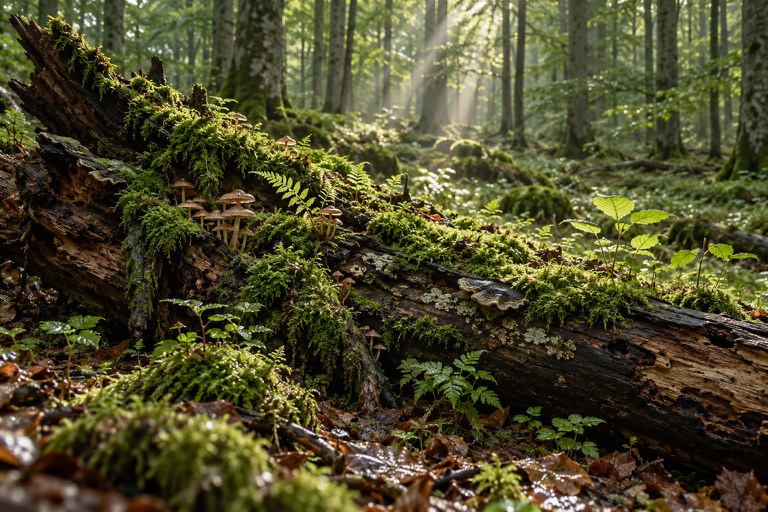
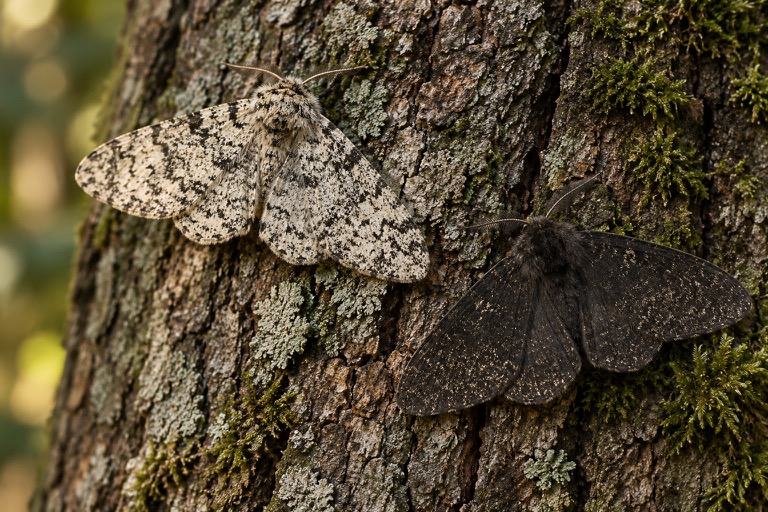
Artistic AI illustration used as a thematic motif, not a documented sample or photograph of the case discussed.
OpenStax · Biology 2e: Ecology of Fungi ↗
Textbook chapter on decomposition, mycorrhizae and lichens. Used for basic material relationships, not to claim that a forest network acts intentionally.
U.S. Forest Service · Lichen Biology ↗
Describes fungal and algal components, layers and attachment of lichens. Attachment threads are not water-conducting plant roots. Not an exhaustive account of associated microorganisms.
Sources checked on 25 October 2026. Comments explain the role and limits of each source.