A rock seems to be the fixed part of a moving world. Clouds pass, water runs away and plants replace their leaves. The stone appears to remain. Yet that contrast is misleading: a rock changes too. The interesting question is not simply whether it breaks down, but which observations can actually reveal which process.
Where the change happens
The National Park Service describes weathering as processes at or near Earth’s surface that break rock apart or chemically alter it in place. That is a useful starting point: a grain need not have travelled anywhere for change to have occurred. An apparently still surface may already reflect a history of transformation. A single view, however, cannot reveal either its duration or its entire past. [1]
Distinguish breaking from transformation
Mechanical weathering changes the size of fragments; chemical weathering changes mineral components. These need not be rival accounts of which exactly one must be true. For a particular rock, they first suggest different questions. Are loose grains present? Has something changed chemically? Which investigation could test the interpretation? An observable shape can make a mechanism plausible without, by itself, establishing that mechanism in this case. [1]
Three questions for one trace in rock.
A labelled conceptual comparison, not a measured time series. Processes can act together; these cards organise questions, not stages in one rock’s life.
- BREAK APART
Mechanical weathering
Is rock divided into smaller pieces while individual minerals retain their chemical composition?
- TRANSFORM
Chemical weathering
Are mineral components chemically altered or dissolved? Discolouration alone does not answer that question.
- MOVE AWAY
Erosion
Is resulting material transported elsewhere? Here the question becomes where the grains go.
Terms follow the NPS explanations of weathering and erosion. The illustrated rock has not been sampled or analysed. [1] [2]
Scotts Bluff: a historical reference
At Scotts Bluff National Monument, the NPS explains weathering and removal using local observations. One caption describes a pipe installed level with the surface in 1933 and used to illustrate subsequent surface lowering. The important idea is the reference: without a documented earlier condition, the pipe’s present position would be just another isolated view. That historical comparison must not simply be projected forward to the present. [2]
Temperature changes stress the material
At Scotts Bluff, the NPS describes expansion with warming and contraction with cooling as mechanical stresses. This makes an otherwise invisible process intelligible: changing conditions can affect rock without chemically transforming its minerals. A warm afternoon does not, however, establish the cause of a particular fracture. The interaction between material and stress matters. This explanation supplies a mechanism, while a specific crack still requires observations of how it formed and which conditions acted on it. [2]
Another story starts after breakdown
Weathering and erosion should be distinguished even when they act together outdoors. At Scotts Bluff, the NPS describes wind and water removing material. Our observation therefore contains two separate questions: has something broken down, and is the resulting material still there? If grains are missing in a later picture, transport may have become visible. That would not yet fully explain what produced the grains in the first place. [2]
A personal comparison needs recognisable conditions
To follow an accessible location over time, start with consistent framing. Choose identifiable reference points, note the date and describe what you observe. Different light can emphasise a crack or make it disappear. A wet surface looks different from a dry one. Such differences belong in the documentation before they are interpreted. They should not quietly become evidence of material loss. Photographs can begin an investigation without constituting a complete laboratory analysis.
Growing crystals can exert pressure
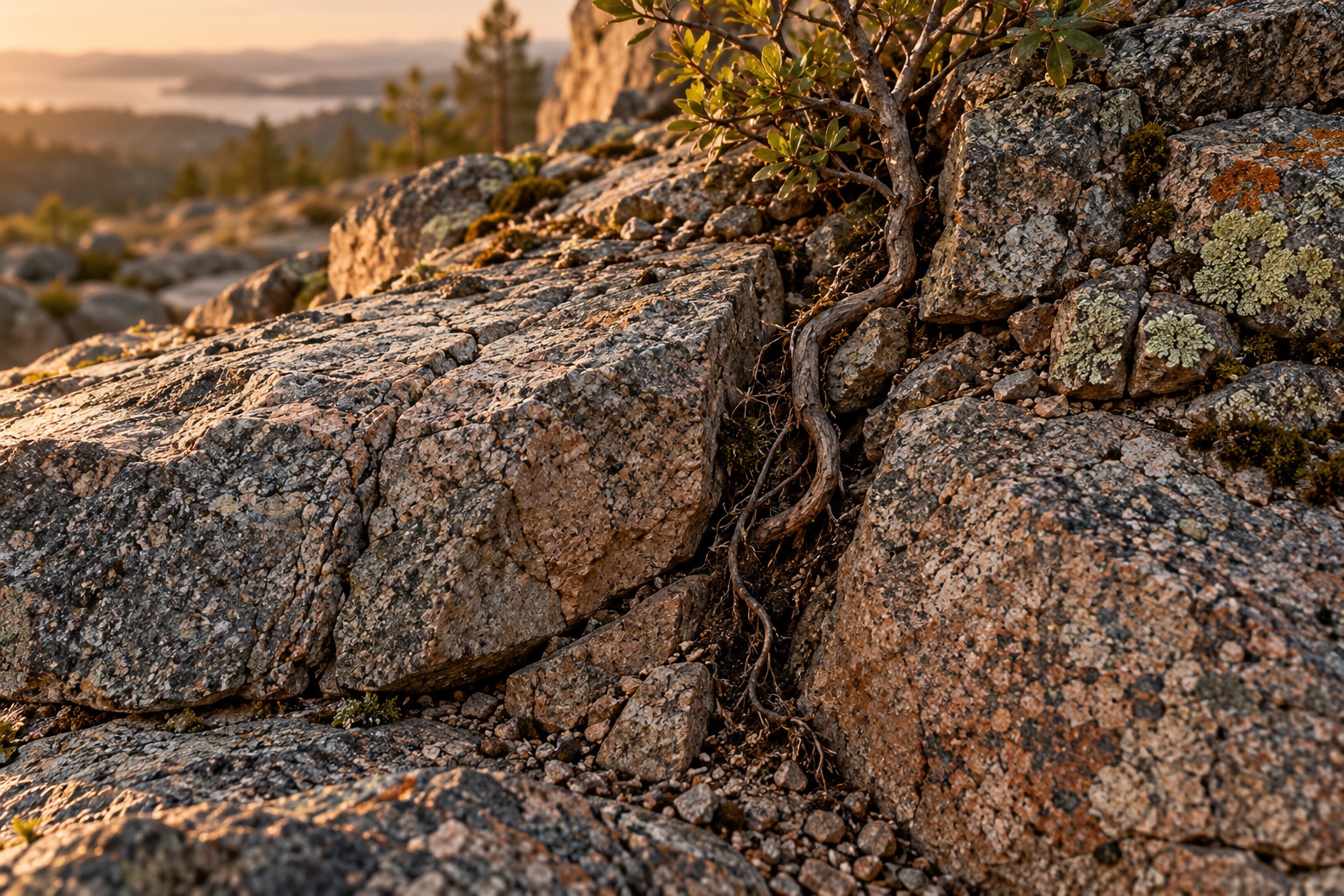
Salt and ice crystal growth are also among the processes described at Scotts Bluff. The point is not merely that salt or water is present, but that growing crystals can mechanically stress surrounding rock. That distinguishes the mechanism from chemical dissolution. Similar-looking fragments can therefore result from different routes. Our artistic granite scene cannot decide between them; the documented sandstone location explains processes without diagnosing every crack in every other type of rock. The material and the evidence still matter. [2]
A closer look is more precise, not merely closer
You can inspect a stone at close range and still rush to a conclusion. “Old”, “fresh” and “split by frost” are interpretations that may need further evidence. A closer look therefore changes the question first. What is directly visible? Which explanation fits? Which alternative remains possible? The rock stays motionless in the picture. Our understanding becomes more flexible because we no longer automatically equate observation, cause and timescale.
An artistic granite illustration, not an image from Scotts Bluff, a geological sample or a dated measurement sequence. The comparison organises possible processes without assigning the picture conclusively to one.
National Park Service · Weathering ↗
Institutional explanation of mechanical and chemical weathering in place, including ice growth and dissolution. It supplies concepts and mechanisms, not a date for our illustrated granite or a universal weathering rate.
National Park Service · Weathering and Erosion ↗
A Scotts Bluff National Monument account published in 2021, distinguishing breakdown from transport and showing a historical pipe marker installed in 1933. Its caption describes a local 75-year comparison, not a measurement series extended to 2026.
Both NPS sources were rechecked in the integrated browser on 24 October 2026. Historical information remains limited to its original observation period.