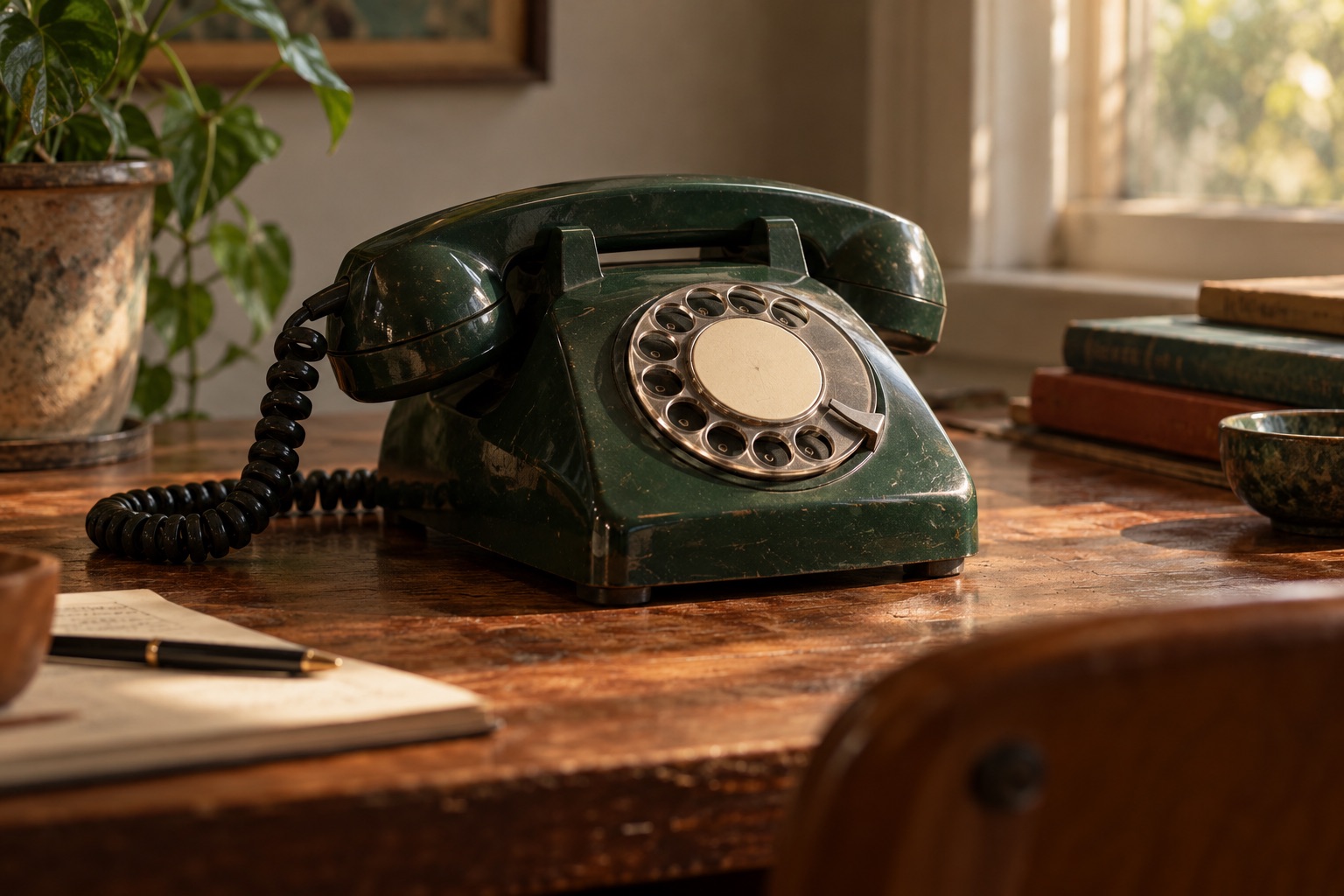
A finger turns the dial and waits for it to return. Someone familiar with that movement needs little explanation. Someone who never learned it may see a puzzle. More than the casing of a telephone can change: gestures, expectations and ownership belong to its history too. Two collection objects help us examine those differences through verifiable details, rather than an indefinite sense of “back then”.
An old telephone gets a precise address
The Smithsonian National Museum of American History holds a pink Western Electric Princess telephone. Its record identifies model 702B and manufacture in September 1969. An object identifier and description accompany those details. This is more precise than an impression of a typical old telephone. The entry concerns one particular item in a collection. Our illustration is instead an independent artistic interpretation and should not be mistaken for a reproduction of that specific museum object. [1]
The product line predates this example
According to the collection, the Princess line was introduced in 1959. Ten years separate the line’s introduction and the manufacture of this surviving device. The dates tell different stories: one belongs to product history, the other to a particular example. Neither dates the invention of the telephone itself. The explanation cards distinguish these levels and add a later teaching object. They create a small historical arrangement without turning three selected points into a complete history of American households. [1] [2]
Three dates, three different things.
A product line, one surviving example and a teaching game. The order is historical; the spacing is not to scale.
- Product history · 1959
Princess is introduced
This dates the line, rather than the surviving 702B example. [1]
- Collection object · September 1969
This example is manufactured
Manufacturing date of the museum’s pink 702B. The illustration does not depict it. [1]
- Teaching material · 1976
Two operating methods in a game
The Telephone Game addresses operation and etiquette with rotary and push-button telephones. [2]
Dates from two Smithsonian collection records, inspected for content on 23 October 2026. None dates the invention of the telephone or a universal switch in how it was operated. [1] [2]
Design offered a place in everyday life
The record identifies Henry Dreyfuss as the designer and describes the compact device as a bedside telephone. A light beneath the dial is among its documented features. The museum also discusses marketing aimed at teenage girls. This reveals something about the advertised use and imagined audience. It does not establish who actually used every individual device, or prove that everyone in that target group owned or wanted one. A design proposal and the full history of its reception are different things. [1]
An object that was not simply sold
The Smithsonian record also explains Bell’s leasing model. Telephones were provided rather than becoming ordinary purchased possessions in the same way; the marking “not for sale” forms part of the object’s history. Looking at ownership changes the familiar picture of a telephone in a room. A device can belong to personal daily life without being owned in the same manner as the table beneath it. This is a documented arrangement within this US context, rather than a statement about every country at the time. [1]
Using a telephone could be a lesson
The second object is The Telephone Game, made by Ideal School Supply in 1976. The museum describes a teaching game for grades two to five addressing telephone operation and etiquette. Rotary and push-button telephones both appear in it. This provides specific evidence of these skills being treated explicitly in learning material. It does not tell us how many schools used the game or how successfully children learned from it. Existence, adoption and measured effectiveness are three different questions. [2]
A movement can become unfamiliar
Turning, allowing the dial to return, lifting and replacing the receiver: describing these movements directs attention towards what using the device asks of a person. They are not quoted instructions from the teaching game. A museum collection can prompt us to name such actions consciously. What one person does without thinking may need to be demonstrated to another. The difference then concerns not only technical knowledge, but familiarity with a particular sequence of movements learned through ordinary use.
What the collection cannot settle for us
Two preserved objects do not form a representative sample of all telephone use. They establish what these devices or materials were and how the museum describes them. Investigating the prevalence of an operating method at a particular date would require different evidence. Memories of one’s own telephone remain valuable, provided they are identified as personal experience. A collection record gives the story a firm anchor; it cannot replace every further investigation that might grow out of it.
See everyday life as a small collection
Which object in our home needs explaining to a visitor today? Which movement feels so obvious that describing it would take effort? A note would not create a museum inventory, but could begin a closer look. Everyday change resides not only in a different machine standing on the table. It also resides in what hands already know, what we expect from one another and which objects we consider our personal possessions. Those quiet assumptions belong to the story too.
The telephone image is an independent artistic interpretation, not a reproduction of the Smithsonian device. The cards distinguish a product introduction, an individual manufacturing date and a teaching object; they show neither a progress curve nor household adoption rates.
Smithsonian National Museum of American History · Western Electric “Princess” Phone ↗
Collection record nmah_1694826, object 2015.0136.01, last read for content in the integrated browser on 23 October 2026. A 24 October revisit reached a verification page, which was not bypassed. Documents model 702B, September 1969 manufacture, the Princess line introduced in 1959, Henry Dreyfuss, dial lighting, target marketing and Bell’s leasing model. One specific US record, not a history of every telephone network.
Smithsonian National Museum of American History · Ideal “The Telephone Game” teacher’s game ↗
Collection record nmah_1213645, object 2003.0030.20: Ideal School Supply, 1976, a teaching game for grades 2–5 addressing telephone use and etiquette, featuring rotary and push-button telephones. Content inspected in the integrated browser on 23 October 2026; a 24 October revisit was limited by a verification page. Documents the teaching material, not its adoption rate or measured learning outcomes. Same institution as source 1.
Museum records last inspected for content in the integrated browser on 23 October 2026. A 24 October revisit was limited by a verification page. The account stays within the previously checked historical information about US objects.