A leaf falls to the ground. Later, its outline becomes difficult to recognise. Yet its material has not simply vanished from the world. Substances are transformed, absorbed by organisms, passed on and sometimes released again. The ground beneath our feet is not a finished foundation. It is a changing habitat whose important participants are easy to miss during a walk.
A fungus is more than its cap
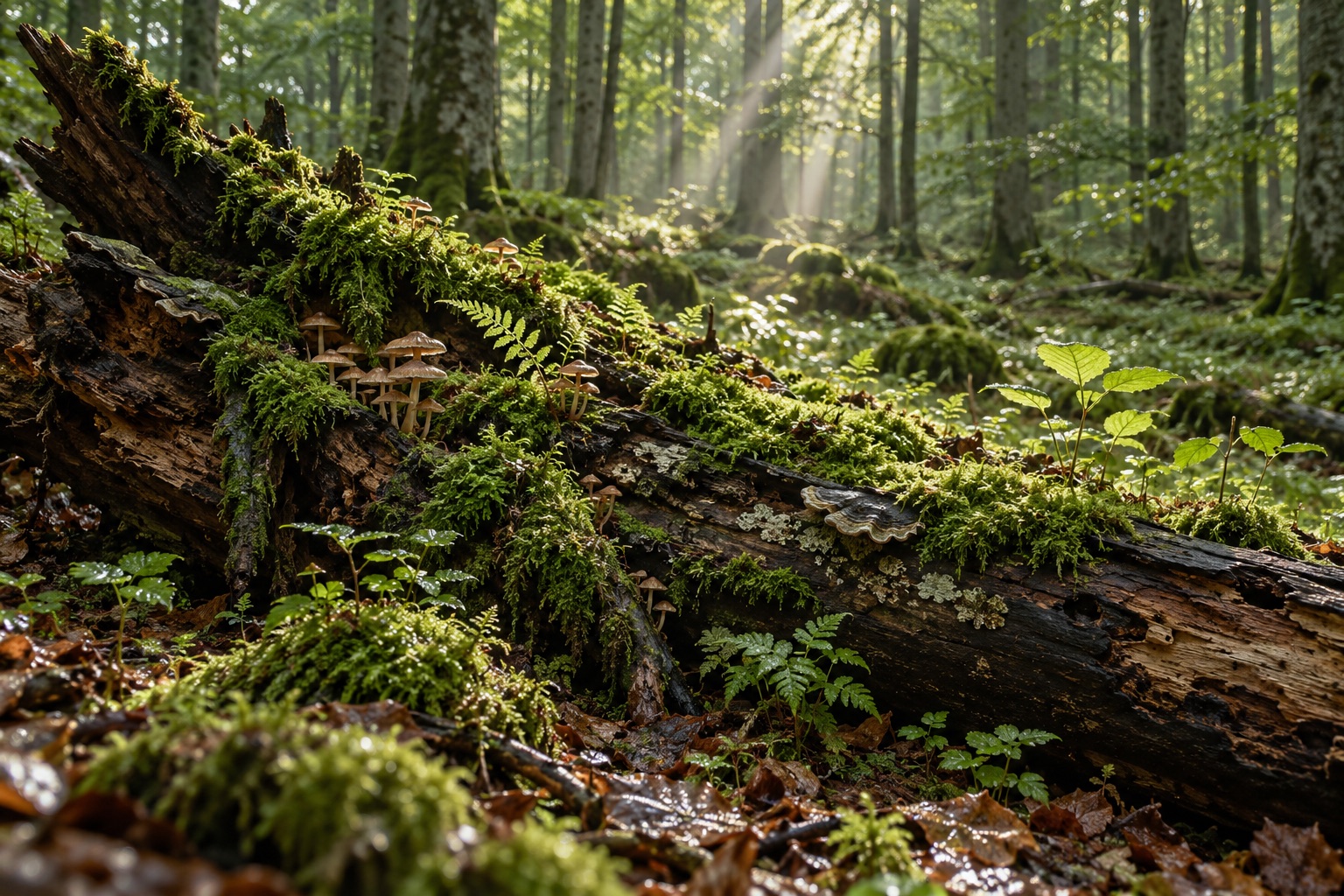
What we recognise as a mushroom is often a fruiting body. The network of hyphae involved in feeding may remain hidden inside wood or soil. The OpenStax chapter explicitly distinguishes visible brackets on a trunk from the threads penetrating the wood. A forest without visible mushrooms is therefore not necessarily a forest without fungi. Conversely, a single fruiting body cannot establish the precise extent of the network to which it belongs. [1]
Digesting before absorbing
Fungi can release enzymes into their surroundings. These break large molecules into smaller components that can be absorbed. Some digestion therefore happens outside the cells. This differs from the familiar picture of an animal swallowing food first. Not every fungus breaks down every material equally well. The description explains a nutritional principle; it does not supply a timetable predicting when a particular branch will have completely decomposed under particular woodland conditions. [1]
A cycle contains many routes
Decomposition makes previously bound nutrients available to other organisms again. OpenStax mentions nitrogen and phosphorus among them. Not every component immediately enters the next plant. Some is first incorporated into living biomass, transformed further or released elsewhere. A simple circular diagram helps organise these relationships. It is not a complete map of every particle moving through real woodland soil, and its neat arrows should not be mistaken for measured quantities. [1]
From a leaf to renewed availability.
Three relationships in a simplified part of a material cycle.
- Connection
Material
A dead leaf contains bound substances.
- Connection
Transformation
Enzymes and organisms transform the material. [1]
- Connection
Availability
Soil organisms change their habitat too
The Soil Biology Primer describes soil organisms as contributors to structure, water availability and nutrient cycling. Soil is consequently more than a store of plant food. Its spaces and the conditions within them are part of the habitat. Fungi work alongside bacteria, small animals and other organisms. Searching for a single leading actor can obscure the many activities taking place together and the different relationships connecting them at the same location. [2]
Moisture is a condition, not a stopwatch
The textbook explains the importance of water for transporting small molecules and supporting active fungal growth. That does not mean every wet patch decomposes at the same speed. Material, temperature, oxygen and the organisms involved belong to a particular investigation. Nor does a photograph of damp wood fully measure those conditions. It records a visible state while many important processes remain hidden inside the material or outside the frame. [1]
Not every encounter is decomposition
Fungi can also interact with living plants. In a mycorrhizal association the fungus receives products of photosynthesis; the plant can receive water and minerals through the fungal network. This differs from breaking down a dead leaf. Both relationships may occur close together. To explain them clearly, however, we must distinguish the organisms involved and the substances moving between them. A single attractive network image cannot tell us which relationship is actually present. [1]
Taking your own closer look
Observe existing leaf litter at an accessible spot without digging it up. Record the date, weather and a recognisable frame for a photograph. A later visit allows visible differences to be compared. These notes cannot identify all the organisms involved or replace chemical analysis. They can nevertheless separate memory from a record. A visit revealing very little outward change still belongs in an honest observation series, rather than being discarded as uninteresting.
An ending creates possibilities
The fallen tree in our other story becomes a habitat. Here we examine the material relationships accompanying that change. Decomposition does more than clear things away: it alters opportunities for further life. Soil remains an open arrangement of organisms, mineral components, water and air. What appears quiet at the surface can therefore invite us to ask about the invisible relationships beneath it, and about the observations that would help us understand them.
Change has many clocks
A second or a million years: the time window changes what we perceive. Explore the scale and open related stories. Examples are observation windows and documented intervals, not universal process durations.
Whole scale: 1 second to 10 million years.
One second
An imagined short observation window: a wave belongs to continuing movement. Not a fixed wave duration.
Read the story →One day
A chosen interval between two notes. Visible difference and cause remain separate questions.
Read the story →Twelve weeks
Duration of the investigation in our habits story. Not a deadline for forming every habit.
Read the story →1984 → 2009
About 24 years between the Las Vegas images. Both exact dates are provided in the comparison.
Read the story →Roughly three decades
Object-specific example: the Statue of Liberty’s green patina. Not a universal clock for copper.
Read the story →One million years
An imagined geological observation window, not a measured weathering time for a rock.
Read the story →None of our examples fall within this window. Move or widen the window.
Logarithmic scale: equal distances represent equal duration ratios, not equal added years. For plotting, years are simplified to 365.25 days. The linked stories explain their sources.
Everything runs in your browser. Your inputs are neither stored nor transmitted.
Another view of change.
Watch free on ARTE. The films complement this story; they do not replace the specialist sources discussed above.
In the kingdom of fungi
Explore the often hidden role of fungi and the question of how dead material creates new opportunities for life.
While watching, consider: Where does the film show decomposition, and where a relationship between living partners?
Listed by ARTE as available until .
Watch on ARTE (German) ↗Listing pages checked on 25 October 2026. Regional restrictions and changes may apply. Links lead to the German version; ARTE may offer other audio or subtitle options. No video player is loaded here.
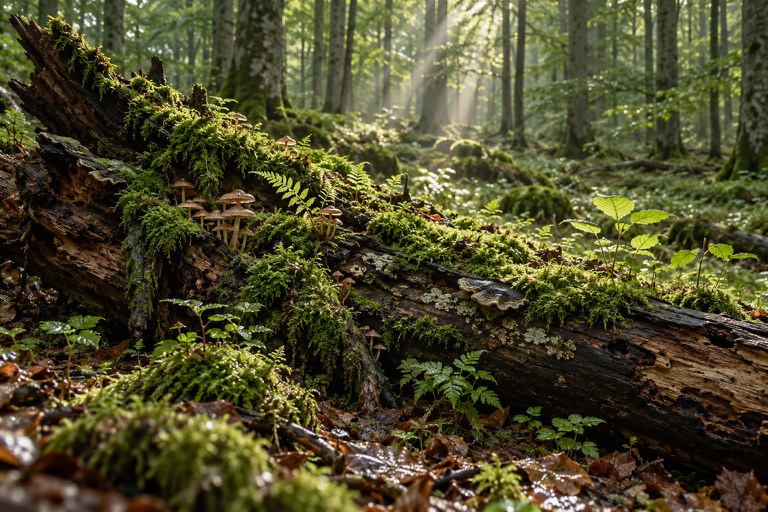
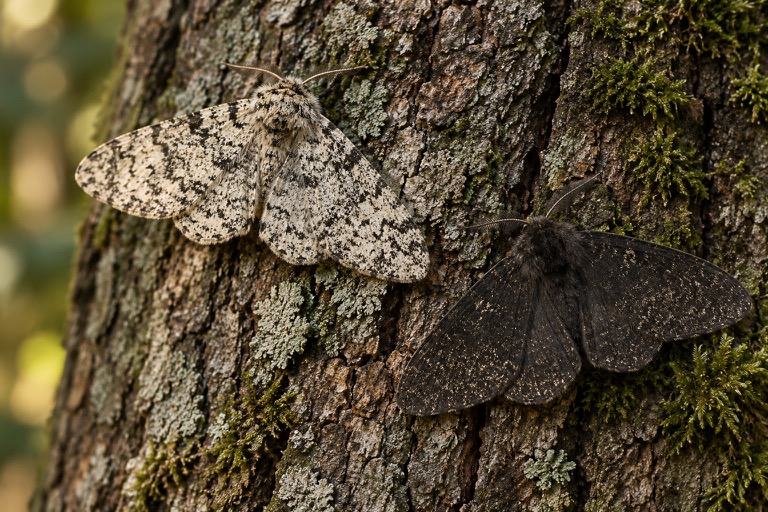
Artistic AI illustration used as a thematic motif, not a documented sample or photograph of the case discussed.
OpenStax · Biology 2e: Ecology of Fungi ↗
Textbook chapter on decomposition, mycorrhizae and lichens. Used for basic material relationships, not to claim that a forest network acts intentionally.
USDA NRCS · Soil Biology Primer ↗
Institutional introduction: soil organisms affect structure, water availability, decomposition and nutrient cycling. Not a measurement series of our illustrated soil.
Sources checked on 25 October 2026. Comments explain the role and limits of each source.